
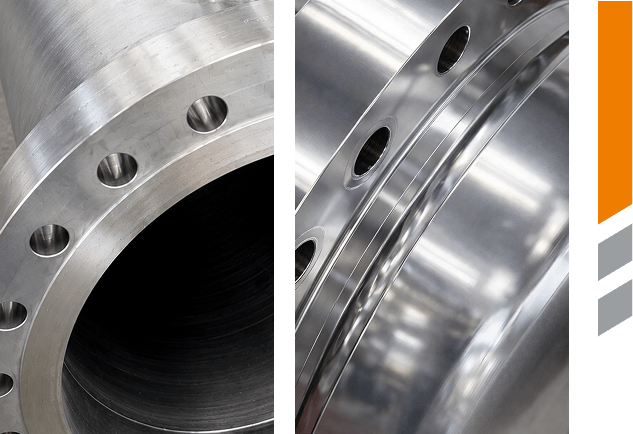
Low-phosphorus electroless
nickel plating
The low-phosphorus electroless nickel plating treatment, indicated
in the Deltar procedure as ENP 23, is an autocatalytic
nickel-phosphorus alloy with a P content between 1% and 4% by weight.
It is the process of choice when the component’s priority is mechanical
performance: high hardness of the “as deposited” deposit, resistance
to rubbing wear and dimensional stability over time.
Typical applications
- Fluid-power and pneumatic components subject to sliding
- Moulds for plastics
- Precision mechanical components with dynamic couplings
- Replacement parts for hard chrome coatings (a more sustainable alternative)
- Components for automotive and extrusion
- Components for hydrogen production plants
The ENP 23 process
at Deltar
The deposition process takes place chemically, without electric current, through an autocatalytic process controlled in every parameter:
- Bath temperature: 85-91 °C
- Bath pH: 4.6-5.2
- Nickel concentration: 4.5-6.3 g/L
- Continuous control of the composition with dedicated electronic instrumentation and daily verification by volumetric titration
The Deltar LS019 procedure complies with the main international standards in the ENP sector: ASTM B117, B183, B322, B499, B571, B578, B602, B636, B656, B689, B733, ISO 4527, MIL-C-26074.
Post-deposition
heat treatments
When required, the ENP 23 deposit can be subjected to heat treatment for two purposes:
Standard quality
controls
Each batch treated with ENP 23 is accompanied by control specimens
(dimensions 50 × 100 × 1 mm in Fe, or supplied by the customer
in a specific material) on which the standard tests are carried out:
- Visual inspection
- Thickness control (weighing method, ASTM B733 par. 9.3.5)
- Adhesion impact test (ASTM B733 par. 9.4.2, ASTM B571)
- Burnishing test (ASTM B571 par. 4.1)
On request, additional controls can be carried out: Vickers hardness,
bend test, porosity test (ferroxyl), phosphorus determination,
salt spray (ASTM B117). At the end of processing, Deltar issues
an Inspection Certificate compliant with the EN 10204 3.1 standard.
What is needed for a quick assessment
- Technical drawing with areas to be treated and to be protected
- Type of base material
- Operating conditions (wear, temperature, friction)
- Required thickness
- Any customer specifications or sector standards