
HEAT TREATMENTS
Optimising the hardness performance of the coating
Heat treatments represent a fundamental stage of the electroless nickel plating cycle, carried out after nickel deposition to improve the mechanical, chemical and structural properties of the coating.
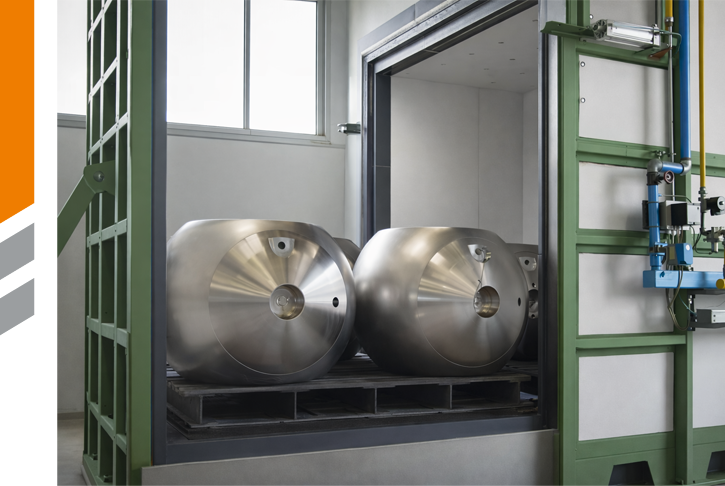
At Deltar we have latest-generation heat treatment furnaces, able to operate up to 700 °C, to carry out controlled cycles on components of any size.
Purposes of heat treatments
Post-plating heat treatments are carried out mainly for two purposes.
Dehydrogenation (ASTM B733 § 6.6)
Dehydrogenation is carried out to eliminate the hydrogen incorporated during the nickel plating process and thus limit the phenomenon known as hydrogen embrittlement. This stage is fundamental for:
- improving coating adhesion
- preventing hydrogen embrittlement phenomena
- guaranteeing the mechanical reliability of the component over time
Dehydrogenation is particularly critical for high-strength steels, where embrittlement can compromise the mechanical performance of the part.
Hardness increase (ASTM B733 – Class 2)
When required, heat treatment allows a significant increase in the hardness of high-phosphorus electroless nickel (ENP 1012).
At temperatures above 280 °C, the amorphous structure of the deposit transforms into a harder crystalline structure, making it possible to reach values up to about 950-1050 HV.
This treatment is recommended for applications subject to wear, friction and high mechanical stress.
How the process works
The heat treatment is calibrated according to the type of nickel deposited, the base material and the required performance. The main controlled variables are:
- Temperature: from 260 °C to 600 °C and beyond, depending on the target hardness
- Time:cycles from 1 to 20 hours, selected to obtain the desired characteristics
- Base material: the choice of parameters takes into account the properties of the substrate, to avoid dimensional or mechanical alterations
For example, to reach maximum hardness (~950/1050 HV), cycles at 400 °C for about 1 hour are adopted, while cycles at lower temperatures (280-340 °C) require longer times but are necessary so as not to alter the mechanical characteristics of the base material (when required or specified).
Advantages of post-plating heat treatments
When is heat treatment recommended?
Heat treatment is recommended:
Note: any surface discolouration due to heat treatment is not subject to Non-conformity and does not compromise the quality of the deposit ASTM B733 § 7.2.1.2.
A tailored treatment, integrated into the Deltar cycle
Thanks to dedicated plants and consolidated expertise, Deltar is able to offer heat treatments perfectly integrated into the electroless nickel plating cycle, ensuring stable and lasting performance even in particularly demanding application contexts.